






HISTORY OF THE MANUFACTORY
Königliche Porzellan-Manufaktur , Berlin (KPM) has a history spanning more than 260 years and is one of Europe’s most important porcelain manufacturers. The following section outlines the most important milestones from its founding in 1763 to the present day.

1763
Frederick the Great founded the Berlin Porcelain Manufactory ( Königliche Porzellan-Manufaktur ) in Berlin. There had already been previous attempts to establish a production facility for “white gold” in Prussia’s capital. However, despite royal support, both the wool manufacturer Wilhelm Caspar Wegely and his successor, the merchant Johann Ernst Gotzkowsky, were forced to cease production due to financial difficulties. Frederick the Great, who had long wanted to own a company that produced precious and prestigious porcelain, paid a considerable sum for the acquisition. He gave the manufactory its name and his emblem, the royal scepter.

1763–1780
The king himself is his own best customer. For his palaces, Friedrich the Great commissions 21 tableware sets comprising up to 500 individual pieces and ornate table centerpieces. Among others, this leads to the development of the RELIEFZIERAT, NEUZIERAT, ROCAILLE, and NEUOSIER designs. Their design and color schemes are tailored to the interiors of the palaces. Frederick’s state gifts also frequently came from the manufactory and graced the tables of European royal houses as well as the Russian imperial court. Even today, distinguished guests of the Federal President dine from the Rocaille service at Bellevue Palace.

1790
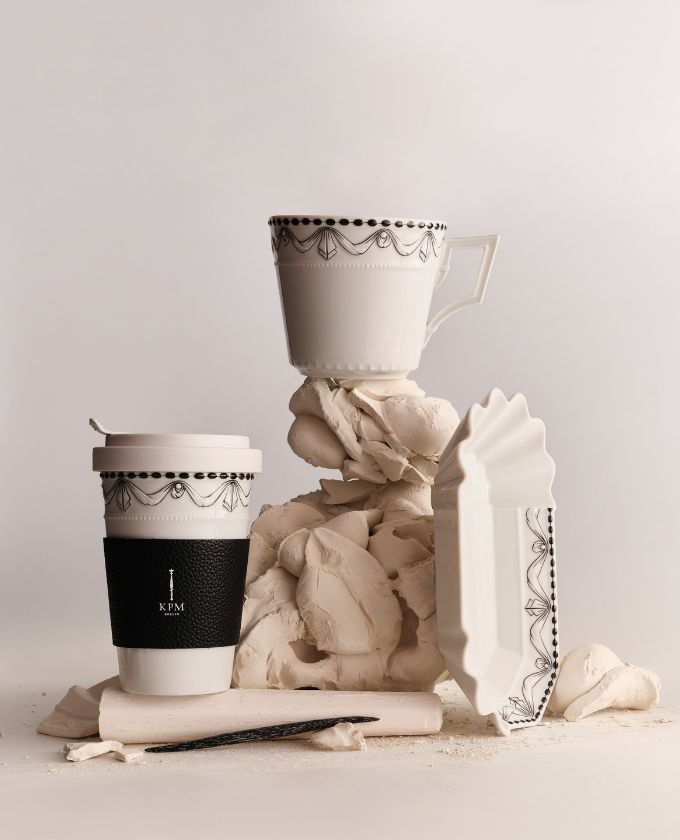
Peter von Biron, Duke of Kurland, commissioned the Berlin Porcelain Manufactory ( Königliche Porzellan-Manufaktur ) to design a magnificent dinner service. To this day, the “ KURLAND ” collection—with its austere neoclassical form and a relief featuring antique drapery, egg-and-dart motifs, and a beaded border—remains one of the manufactory’s bestsellers and is considered arguably the world’s most significant neoclassical collection. The “ KURLAND ” border now also adorns “white gold” to-go cups and currywurst bowls. For larger state receptions, a “ KURLAND ” service is kept on hand at Charlottenburg Palace.

KPM in Leipziger Straße 1763-1871

1790–1830
Following the death of Frederick the Great in 1786, Frederick William II took over the Berlin Porcelain Manufactory ( Königliche Porzellan-Manufaktur ) and transformed it into a technologically leading enterprise—featuring Berlin’s first steam engine and horse-drawn glaze mills. The manufactory’s economic fortunes soared.
In terms of design, Karl Friedrich Schinkel, Johann Gottfried Schadow, and Christian Daniel Rauch left their mark on KPM porcelain. Their designs were no longer as whimsical as during the Rococo period but drew inspiration from classical forms with clear contours and harmonious proportions. The “Princess Group,” based on a design by Johann Gottfried Schadow, dates from this period. The intricately crafted statue, consisting of 88 individual parts, depicts Crown Princess Luise of Prussia and her sister Friederike. The “Schinkel Basket” by Karl Friedrich Schinkel—still produced today—features a filigree, openwork basket weave and is part of a service commissioned by Frederick William III for his eldest daughter’s wedding.

1873
KPM Berlin . must make way for the construction of the Prussian State Parliament and leave its location near Potsdamer Platz. It is moving to the edge of the Tiergarten, which offers a major advantage: The new production facility, equipped with a modern ring kiln, is located directly on the Spree River and is accessible by boat.

kpm Premises in Tiergarten, 1871–1943

1878
In 1878, the Chemical-Technical Research Institute was founded as a department of KPM. Its director, Hermann Seger, developed a softer porcelain body that could therefore be fired at a much lower temperature, as well as a wide variety of new glazes (crystal glazes, oxblood glazes, etc.). KPM thus followed a European trend that had begun in Sèvres and became a leading manufacturer in this field.

1895–1915
The designers at the KPM Berlin turned away from historicism and embraced flowing, asymmetrical, and organic forms. The CERES dinner service, designed by the manufactory’s artistic director, Theodor Schmuz-Baudiß, is today considered one of the most beautiful Art Nouveau dinner services. It was introduced to the market in 1913 to mark the manufactory’s 150th anniversary.

1931
With the abdication of the Hohenzollerns in 1918, the Berlin Porcelain Factory ( Königliche Porzellan-Manufaktur ) became the State Porcelain Manufactory of Berlin (Staatliche Porzellan-Manufaktur Berlin). Under its director, Günther von Pechmann—chairman of the German Werkbund—the ideas of New Objectivity influenced the work of KPM Berlin. The era of elaborate ornamentation was over; less was more. In 1931, Trude Petri designed the URBINO dinner service, which won the Grand Prix at the 1937 World’s Fair and is now on permanent display at the Museum of Modern Art in New York.

1938
To mark the 175th anniversary of the manufactory, the “ ARKADIA ” tableware set has been created. The simple design was conceived by Trude Petri, and Siegmund Schütz—inspired by Greek mythology—adorned it with medallions made of bisque porcelain.

1943–1955
In November 1943, 80 percent of the factory’s railings were destroyed in a bombing raid. The Berlin State Porcelain Factory moved into exile in Selb, Bavaria. After the buildings were rebuilt, the factory was able to return to the Tiergarten in 1955.

KPM 1955–1998

1987
With the URANIA dinner service, the manufacturer is responding to the demand from high-end restaurants for wide plate rims without relief decoration. Since 1987, the “ Arkadia ” tableware set has therefore been offered in the product line without the bisque medallions designed by Siegmund Schütz. In 1988, the manufactory was reorganized into a limited liability company (GmbH) under private law owned by the State of Berlin. To mark this occasion, the company reverted to the name “Königliche Porzellan-Manufaktur , Berlin.”

1996
Asymmetry and abstraction replaced the austere forms of the earlier Bauhaus era. In the 1990s, a collaboration with Italian designer Enzo Mari led to the creation of a series of slender vases with square stainless-steel bases, as well as the “ BERLIN ” collection—which won the iF Design Award—featuring concave and convex-shaped panels.

2006
After several attempts at privatization, Berlin banker Jörg Woltmann took over the Berlin-based watchmaker “ Königliche Porzellan-Manufaktur ” as its sole shareholder. Woltmann oversaw the restructuring of this long-established company and has continued to guide the manufactory to this day.

2007
The opening of “The World of KPM,” a permanent exhibition chronicling the manufactory’s rich and varied history, marks the completion of a ten-year restoration and modernization project at the KPM site.

The World of KPM at the KPM Flagship Store

2016
Head designer Thomas Wenzel draws inspiration from the manufactory’s former laboratory porcelain and has designed the LAB series—not a classic multi-piece dinner service, but a range of multifunctional and minimalist products for the modern kitchen laboratory. A glossy glazed top and a matte underside made of “ biscuit porcelain ” give the pieces a unique tactile quality. In addition to plates, bowls, and mugs, the LAB family includes spice mills, mortars, and a porcelain coffee filter, among other items. Each member of the family is recognizable not only by its timeless design but also by the chrome-green stamped mark and the lettering “BERLIN.”

2017
KPM Berlin has launched a collaboration with artist Stefan Marx, bringing together contemporary art and traditional craftsmanship. Encouraged by the positive response, the manufactory has since regularly engaged in creative exchanges with contemporary artists and designers and launched limited-edition pieces and products under the KPM+ label.

2018
The KPM To-go cup is regarded as a symbol of a living symbiosis of tradition and contemporary spirit, style and environmental awareness, and is the most commercially successful product since the manufactory was founded.

2022
The MANDORLA collection evokes memories, as the “ decor ” is inspired by industrial-grade protective panels designed to shield walls and floors from excessive wear and tear. Stuttgart-based artist Reiner Xaver Sedelmeier inspired KPM’s chief designer, Thomas Wenzel, to embark on an artistic collaboration in which seemingly mundane everyday design is translated onto high-quality porcelain. The result is “ jug,” “ cup ,” and vases made of “ biscuit porcelain ”—all of which are cylinders cast in the typical elliptical shapes of the protective metal.

2023
To mark the 260th anniversary of KPM Berlin, we pay tribute to one of its most significant designers of all time: Marguerite Friedlaender-Wildenhain. With the reissue of the airplane mug, the “ Königliche Porzellan-Manufaktur ” is offering a true rarity of the New Objectivity movement.